Kappa Test
 |
 |
 |
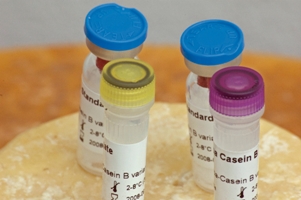 |
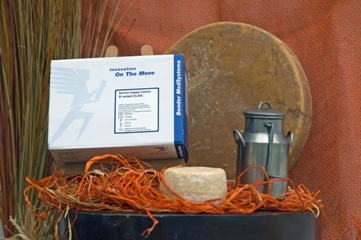
The new Kappa Test determinates the amount of Type-B k-Casein in cow milk, regardless of the cow breed.
It has been demonstrated that milk containing only k-Casein B (obtained from cows belonging to the type-B genetic variant) gives a higher cheese yield then milk with only type-A or AB k-Casein. Furthermore, in comparison to these less profitable variants, k-Casein B milk coagulates in a shorter time and gives firmer curds which can be more easily processed and drained, whose cohesion gives cheese with better rheological properties and higher calcium and phosphorus contents. Even the general structure and the sensorial properties of cheese, milk and yogurt improve.
Kappa Test allows the dairy industries to monitor all incoming bulk milk and to set a quality policy addressed to individual farmers, aimed to prize those ones who select their cows and provide milk with only or mainly k- Casein B. Benefits Traditional ELISA test in microplate of 12 x 8 wells
Accurate results within about 4 hours
No need to pre-treat the milk samples Useful to analyze bulk cow milk or milk from individual farmers/cows, regardless of the breed Frozen or preserved milk samples do not affect the results Kappa Test allows to set a prize policy based on higher contents of k-Casein B Kappa Test allows to get better yields, better curd firmness and higher quality “It is estimated that the actual yield of cheese in a plant producing 20,000 tonnes per year from k-casein AA milk would increase to approximately 21,180 tonnes of Cheddar, or 21,780 tonnes of Mozzarella if made from k-casein BB milk.”
R. J. Fitzgerald et al. – University of Limerick, Ireland “The yield of Parmigiano Reggiano increases of +6 kg per cauldron if only k-casein milk is processed compared to the yield of Parmigiano Reggiano from only k-casein AA milk.”
P. Mariani et al. – University of Parma, Italy